


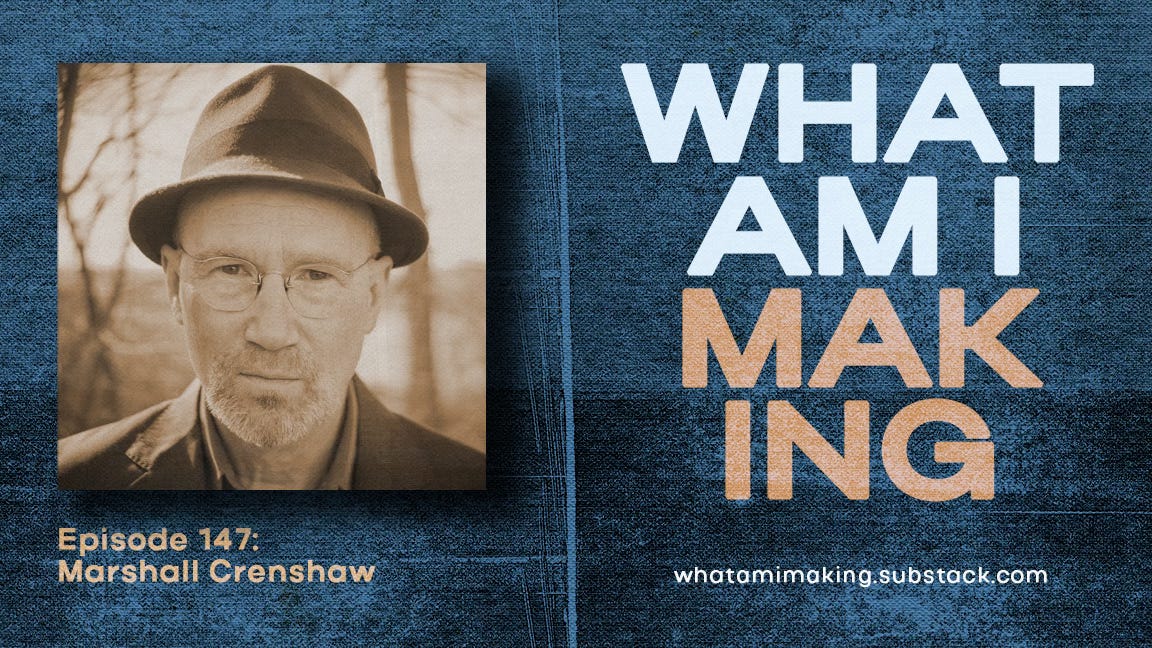
You can hear the raw and unguarded version of today’s guest when you listen intently to The Bootleg Recordings Of Marshall Crenshaw. This new collection of Crenshaw originals, which was released on Record Store Day of this year, was culled from a trove of work tapes recorded while making his third and fourth albums. These recordings afford listeners and fans the opportunity to hear a host of unvarnished material, exposing the blood and bone of the songs.
Marshall Crenshaw grew up in the leafy post-war suburbs of Detroit, Michigan. Although Motown, The MC5, and the glitter of the big city were just minutes away by car, the Crenshaw family largely stuck to the safety of the streets near their home, eschewing all that Detroit had to offer, except on the rare occasion of a ball game or a trip to see holiday lights.
After high school, Crenshaw found himself with dwindling prospects at home and hit the road for New York and then eventually Los Angeles. He auditioned for bands, performed in the touring company for Beatlemania, and shopped his songs to any producer or label that would take the time to listen. Eventually, Crenshaw landed a deal with the small Imprint Shake Records which released his debut single, “Something’s Gonna Happen” in 1981. On the strength of that single and a few other demo recordings, Crenshaw inked a deal with Warner Bros. Records.
Marshall Crenshaw’s first two albums, Marshall Crenshaw and Field Day found both critical and commercial success, and landed Crenshaw in a pair of Hollywood roles. He appeared first in Francis Ford Coppola’s Peggy Sue Got Married as part of the wedding band that is prominently featured in the film. Later in the same year, Crenshaw appeared in La Bamba as the ill-fated first wave rocker, Buddy Holly.
During our conversation, Marshall and I discuss his childhood in Detroit and his urge to get out once he had reached adulthood. We cover his early days in both New York and LA, including a riveting story about a compromised producer that inadvertently gave Crenshaw the confidence to produce his own records. We talk about being in over your head, and learning to swim your way out. Plus, we cover helping to maintain the legacy of another great power pop band of the 80s and 90s. It’s a great conversation with a truly unique artist still working at a very high level.
Let’s get into it.
Cheers,
Matty C


